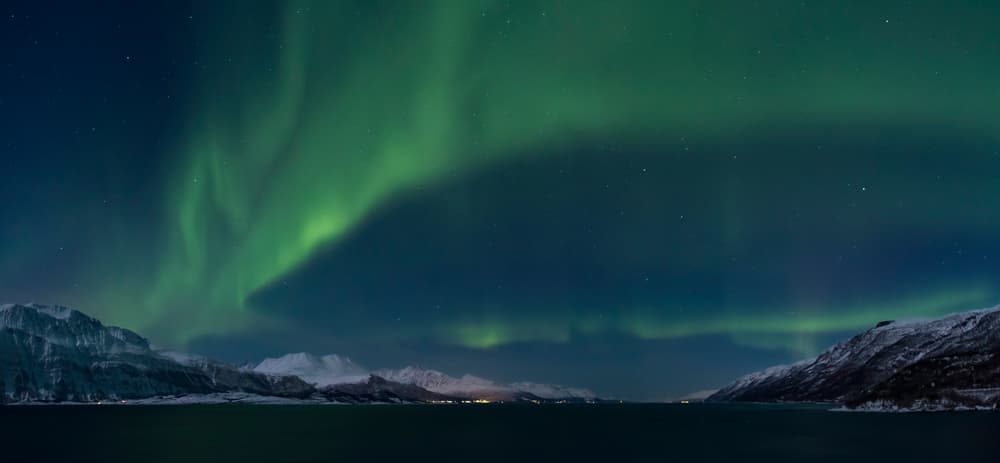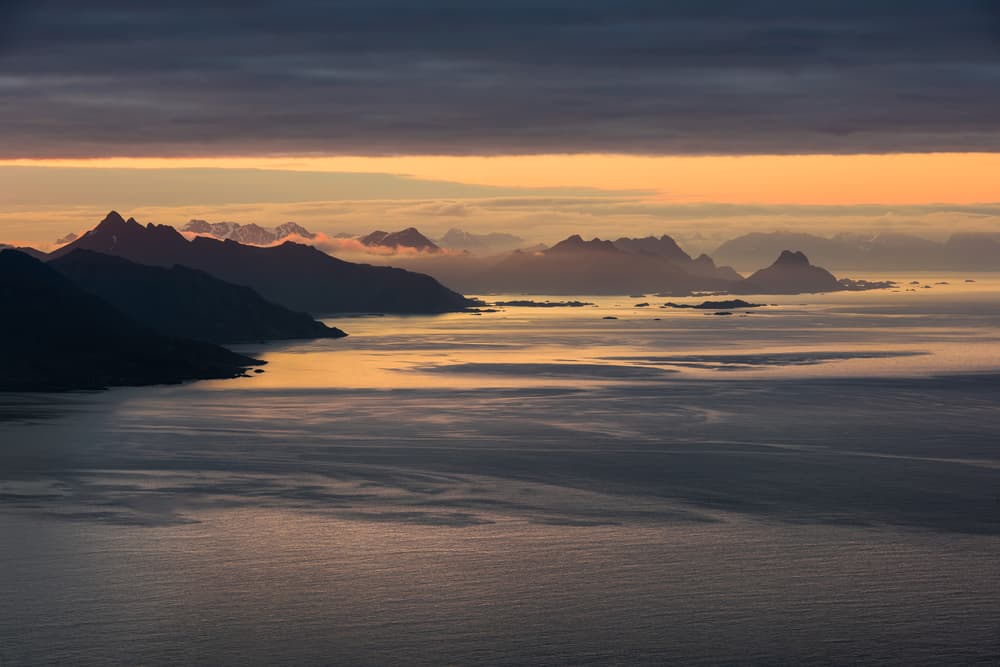
The Arctic year is governed by light. North of the Arctic Circle the sun stays above the horizon for weeks or months in summer and below it for a similar period in winter, and nearly everything a traveller might want follows from that. Northern lights need darkness, so they belong to autumn, winter and early spring. Boats, birds and hiking need open water and thawed ground, so they belong to summer. Snow sports are best when the light has returned but the ice is still hard.
So choose the experience first and the month will follow. The sections below explain the main cycles; each destination has its own detailed page with a temperature table.
Midnight sun, polar night and northern lights
The midnight sun lasts one day at the Arctic Circle and lengthens northwards: about two months in Tromsø (20 May–22 July), two and a half at North Cape, four in Longyearbyen (20 April–22 August) and six at the Pole. Polar night mirrors it in winter — roughly late November to mid-January in Tromsø, late October to mid-February in Longyearbyen. Even then it is not pitch dark all day: around noon, towns below about 72° north get a few hours of blue and pink twilight.
The northern lights occur all year but can only be seen in a dark sky, which rules out roughly mid-April to late August in most of the Arctic. The season runs from September to early April. The aurora is commonest in a ring around the magnetic pole that passes over northern Norway, Iceland, southern Greenland, northern Canada and central Alaska; Svalbard lies north of it and sees fewer, though sometimes daytime, displays. Clear weather matters more than anything else.
It follows that you cannot combine midnight sun and northern lights. The nearest thing is early September or late March, when the nights are dark, the days are a normal length and, in September, the sea is at its most open.
The four Arctic seasons
Polar night (November–January). Dark, atmospheric and — in northern Norway — busy around Christmas. Best for aurora and for whales in the Norwegian fjords. Daylight activities are squeezed into a few twilight hours; the high Arctic beyond Svalbard is closed.
Light winter (February–April). The Arctic’s second high season. Snow cover is at its deepest, sea and lake ice are safest, days lengthen quickly and the aurora is still visible at night until early April. The best period for dog sledding, snowmobiling, skiing and ice-hotel stays.
Summer (May–August). Continuous daylight, breaking ice, returning birds and whales, tundra flowers and all transport running. Expedition cruises operate from about June; the Canadian and Greenlandic high Arctic open in July and August. Cool rather than warm, with fog on the coasts.
Autumn (September–October). Sea ice reaches its annual minimum in mid-September, so ships can go furthest. The tundra turns red and gold, darkness and aurora return, and visitor numbers fall. By late October most summer services have ended.
The Arctic month by month
| Month | What it is like | Best for |
|---|---|---|
| January | Polar night north of about 68°; coldest month in many places. The sun returns to Tromsø mid-month. | Northern lights, whales off northern Norway (to late January), winter festivals |
| February | Light returning fast; deep snow; very cold inland and in the high Arctic. | Aurora, dog sledding, snowmobiling, ice and snow hotels; the Svalbard season begins |
| March | Long bright days on firm snow; aurora at night until the end of the month. | The best all-round winter month in Norway and Svalbard; dog sledding in Greenland |
| April | Midnight sun begins in Svalbard; the snow season continues in the high Arctic while the coasts thaw. | Svalbard snowmobile expeditions, ski touring, North Pole ice-camp season, late skiing in Iceland |
| May | Break-up: snow and ice going, summer services not yet running. Birds arrive. Midnight sun in northern Norway from mid-month. | Seabird cliffs, floe-edge wildlife on Baffin Island, quiet travel and low prices |
| June | Midnight sun everywhere north of the Circle; first boats and cruises; tundra greening. | Midnight sun at North Cape, puffins, whales in Iceland, early Svalbard cruises |
| July | The warmest month; all roads, ferries and boats operating; busiest and most expensive. | Greenland’s icefjord, Svalbard wildlife cruises, the Dempster and Dalton highways, North Pole voyages |
| August | Still light but nights return late in the month; least ice in most seas; first autumn colour. | Northwest Passage and East Greenland cruises, whale watching, hiking; first aurora at month’s end |
| September | Sea-ice minimum; dark nights; autumn tundra; far fewer visitors. | Scoresby Sund, aurora with open water, late cruises, good value in Norway and Iceland |
| October | Rapid cooling, first snow, short days. Many summer operations closed. | Northern lights, polar bears at Churchill, quiet towns |
| November | Polar night begins; snow cover builds; herring and whales enter the Norwegian fjords. | Whale safaris from Tromsø and Alta, aurora, Churchill’s bears until mid-month |
| December | Darkest month; festive and busy in northern Norway; extreme cold in Canada, Alaska and Greenland. | Aurora, whales, Christmas in Tromsø, the opening of the ice hotels |
Seasonal limits to plan around
- Boat trips in Svalbard run roughly from May to October; snowmobile trips from about February to mid-May. Between seasons, neither is reliable.
- Whale watching from Tromsø and Alta depends on herring and normally lasts from early November to late January. Húsavík’s main season is April to October.
- Scoresby Sund in East Greenland is usually blocked by pack ice until early or mid-August; the Northwest Passage is navigable for only a few weeks in August and September.
- The Dempster Highway closes for several weeks in spring and autumn while its river crossings freeze or thaw. The Prudhoe Bay shuttle to the Arctic Ocean runs in summer only.
- The last section of road to North Cape may be convoy-only from October to April; ice hotels in Alta open from late December to early April.
- Seabirds leave their cliffs by mid-August. Puffins are best seen from May to early August.
Festivals and events
- January: Tromsø International Film Festival; Ilulissat and Longyearbyen mark the approaching return of the sun
- 6 February: Sami National Day, with a week of events in Tromsø, Alta and Kirkenes
- March: Finnmarksløpet sled-dog race from Alta; Longyearbyen’s sun festival; World Ice Art Championships in Fairbanks
- April: Toonik Tyme in Iqaluit; dog-sled races in Greenland; Svalbard Skimaraton
- June: Midnight Sun Marathon in Tromsø; Nalukataq whaling feast in Utqiaġvik; North Cape Festival
- 21 June: Greenland’s National Day and National Indigenous Peoples Day in Canada; solstice celebrations on Grímsey
- July: Great Northern Arts Festival in Inuvik; World Eskimo-Indian Olympics in Fairbanks
- Mid-September: Annual minimum of Arctic sea ice
- October–November: Polar bear season at Churchill; Dark Season Blues in Longyearbyen
Dates shift from year to year; confirm them with the organisers before planning around an event.
Timing FAQs
What is the best month to visit the Arctic?
March for winter — snow, light and aurora together — and late August to mid-September for summer — open water, wildlife, autumn colour and the first dark nights.
When can I see the northern lights?
From September to early April, on clear, dark nights. Tromsø, Alta, Kirkenes, North Iceland, Yellowknife and Fairbanks are all well placed.
When is the midnight sun?
Between about mid-May and late July at the latitude of Tromsø and North Cape, and from late April to late August in Svalbard.
When is the best time for wildlife?
June to August for seabirds, whales, walrus and Svalbard’s polar bears; November to January for orcas and humpbacks off northern Norway; October and November for polar bears at Churchill. See the wildlife guide.
When is the cheapest time?
May and early June, and September to mid-November outside Churchill. Flights and hotels are cheaper and tours less crowded, at the cost of less predictable conditions.